
Shifting Tides: Lab-Grown Diamonds Just Reached a Massive Global Milestone
What it Means for Your Engagement Ring Budget
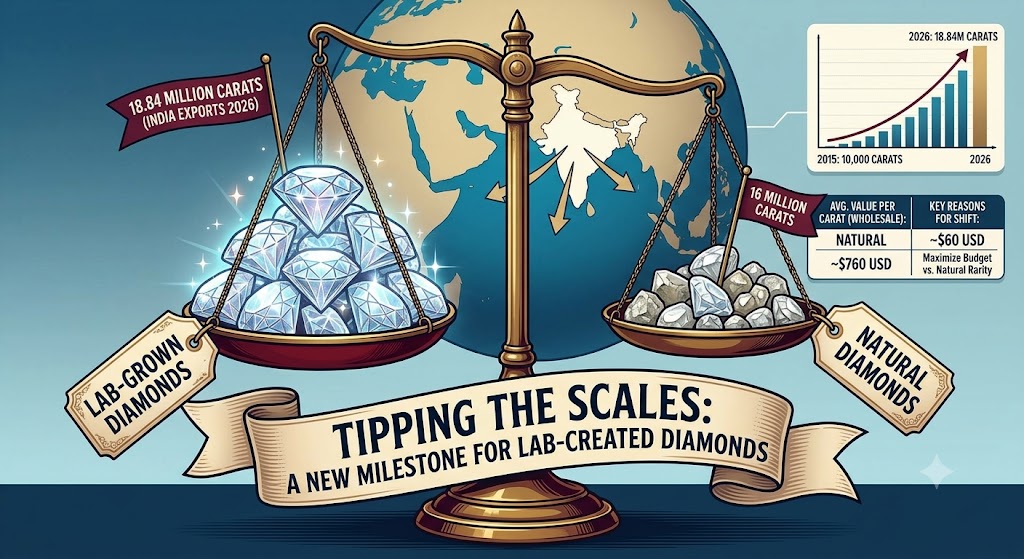
The global jewelry landscape has officially crossed a major psychological threshold. For the first time, India—the world’s absolute powerhouse for diamond cutting and polishing—has exported more carats of polished lab-created diamonds than natural ones.
Data released by the Gem and Jewellery Export Promotion Council (GJEPC) reveals a striking divergence in the market for the fiscal year ending March 2026:
- Lab-Grown Diamonds: Exports surged by 31%, climbing to a staggering 18.84 million carats.
- Natural Diamonds: Exports slipped by 4%, dropping down to 16 million carats.
While industry insiders suspect the actual “tipping point” occurred even earlier, this marks the first time official data has definitively captured lab-grown diamonds taking the volume crown.
From Niche Alternative to Mainstream Superpower
To understand just how fast this shift happened, look back a decade. Between 2015 and 2016, India exported a mere 10,000 carats of lab-grown diamonds. Today, that number has multiplied by nearly 1,900 times. Driven by rapid technological advancements, cheaper production costs, and massive consumer adoption, what was once a niche alternative has become the default choice for millions of couples.
Industry analyst Edahn Golan notes that lab-grown creators successfully capitalised on a simple, powerful message: We are optically, chemically, and physically identical to natural diamonds—just without the premium price tag. By perfectly mirroring the product while slashing the cost, they completely changed how everyday consumers shop for fine jewelry.
What Does This Mean for Your Budget?
The price disparity between the two sectors has widened into a canyon. Because lab-grown diamonds can be consistently grown in high-tech facilities, a massive influx of supply has driven their wholesale value down significantly.
Meanwhile, natural diamonds retain a steep scarcity premium.
| Diamond Type | Average Wholesale Value (Per Carat) | What Your Budget Actually Buys in 2026 |
| Lab-Created Diamond | ~$60 USD | Massive Buying Power: A $1,500 budget can easily secure a stunning, premium 2-to-3-carat loose stone or a fully set engagement ring. |
| Natural Diamond | ~$760 USD | Premium Rarity: A $1,500 budget will limit you to a smaller stone (around 0.40ct) or lower clarity/color grades. A benchmark 1ct D/VVS2 stone requires a larger investment. |
The Verdict: How to Choose at the Crossroads
With lab-grown diamonds now thoroughly dominating the mainstream market, deciding between the two comes down to what you value most for your milestone ring:
- Choose Lab-Grown If: You want to maximize your budget. If you want a 2-carat look on a 0.50-carat budget, prioritizing pure visual impact, size, and sparkle over historical resale value, lab-grown is your winner.
- Choose Natural If: You are a traditionalist. If you value the romance of a finite stone formed deep within the Earth billions of years ago, and you view your purchase as a long-term, upscale family heirloom that preserves intrinsic value, natural remains the undisputed king.
Why the Natural Diamond Market is Moving Strictly Upscale
The global diamond trade has officially entered a new economic era. According to recent data from the Gem and Jewellery Export Promotion Council (GJEPC) for the fiscal year ending March 2026, India—which polishes roughly 90% of the world’s diamonds—has exported more carats of polished lab-created diamonds than natural ones.
The numbers highlight a tectonic shift in product volume:
- Lab-Grown Exports: Surged 31% to 18.84 million carats.
- Natural Exports: Declined 4% to 16 million carats.
While lab-grown diamonds now rule the kingdom of quantity, an entirely different story unfolds when you look at value.
Volume vs. Value: Two Completely Different Orbits
Despite losing volume leadership, natural diamonds continue to absolute dominate the financial health of the jewelry trade. The economic reality is that these two products now occupy completely separate market ecosystems.
“While lab-grown diamonds may be capturing consumer attention, they are not capturing the same share of spending,” notes veteran industry analyst Edahn Golan.
The price gap between the two categories is structural, stable, and massive. Lab diamonds currently trade at wholesale prices roughly 88% to 92% lower than natural stones of identical specifications.
- The Natural Anchor: A single natural carat commands an average wholesale price of $760 USD. Because of mining cost structures and finite geological supply, natural diamonds function as an upscale luxury asset.
- The Lab Commodity: A factory-grown carat trades at an average wholesale price of $60 USD (with rough input costs hovering around $15 USD). It operates as a highly efficient, high-volume consumer commodity.
The Marketing Blind Spot and the Rise of “Ultra-Luxury”
The rapid volume takeover by lab-grown stones points to a historic blind spot in traditional diamond marketing. For years, the industry failed to establish a strong, status-driven differentiation for mined stones. Lab-grown producers brilliantly exploited this by proving their stones were chemically identical, rendering the “origin story” irrelevant to budget-conscious buyers.
However, this isn’t a doomsday scenario for the natural market. Instead, it is forcing a massive structural evolution:
- Natural Diamonds are Going Strictly Upscale: Major mining houses, such as De Beers, are pouring their largest marketing budgets in 15 years into campaigns targeted heavily at independent jewelers. Natural diamonds are being repositioned away from commercial bridal and steered directly into the ultra-luxury, high-carat, and rare colored stone markets.
- Lab-Grown is Capitalizing on Fashion & Scale: The lab-grown market is expanding rapidly into fashion jewelry, watches, and accessories, maintaining incredible margins through volume rather than scarcity premium.
The Long-Term Outlook for Collectors and Jewelers
For designers, retailers, and collectors, the lines are now clearly drawn in the sand.
Lab-grown diamonds have successfully democratized the look of luxury, making large, visually flawless stones accessible to the mass market. Concurrently, natural diamonds are solidifying their status as an exclusive, high-value asset class defined strictly by rarity, asset preservation, and elite prestige. The market has split, and both sides are thriving in their own distinct orbits.
